
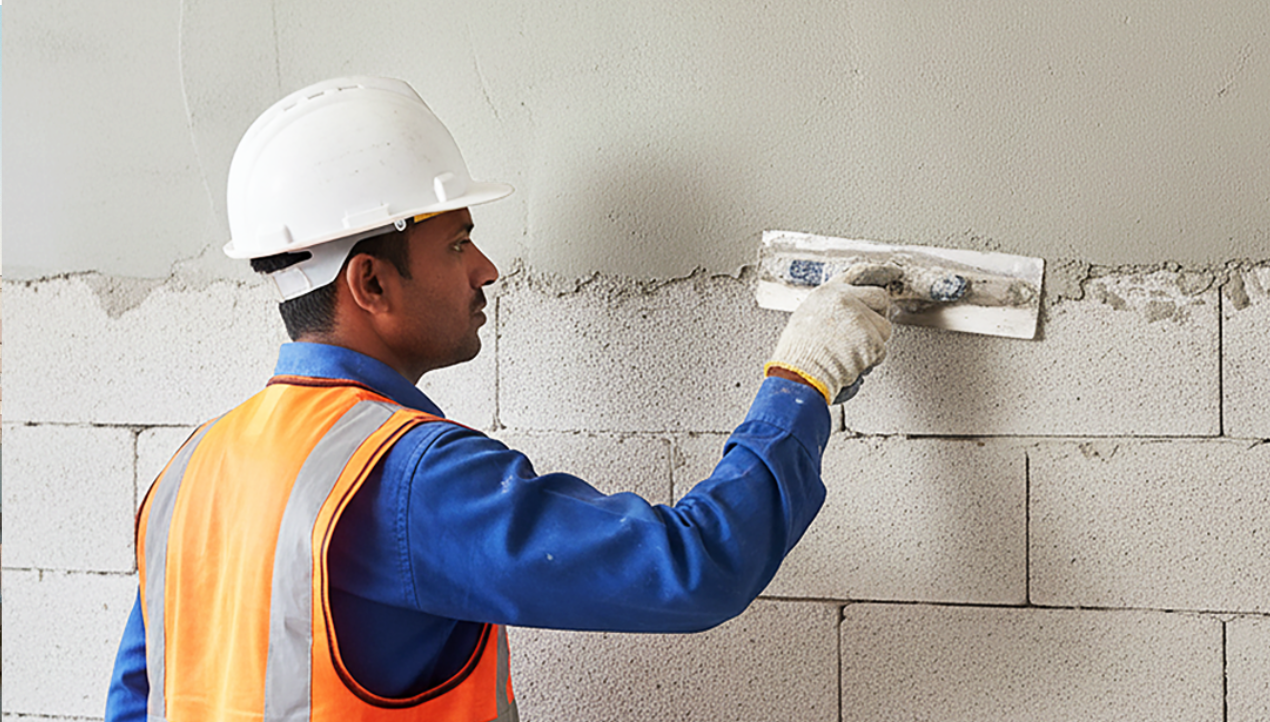
Since 2012, we have been producing building products to offer complete walling solutions to our customers by continuing to innovate, pioneer new products, and launch specialised services. This has helped us build trust in Gujarat and around India. We are leading manufacturers and suppliers of Brixo AAC Blocks and Wallflex AAC Wall Panels.
At Contis, we invest in technology to build a better tomorrow, and we are aware that our industry’s future lies in embracing technological advancements. We have installed industry-leading plant and machinery equipped with the latest technological advancements, along with an experienced team, to produce the highest-quality products and deliver the best value to our customers.
Autoclaved Aerated Concrete (AAC), was first manufactured in the mid-1920s by the Swedish architect and inventor, Dr. Johan Axel Eriksson, working in collaboration with Professor Henrik Kreuger, at the Royal Institute of Technology. Although the process was patented in 1924, production started in Sweden in 1929. The second major autoclaved production plant opened in 1943 in Germany.
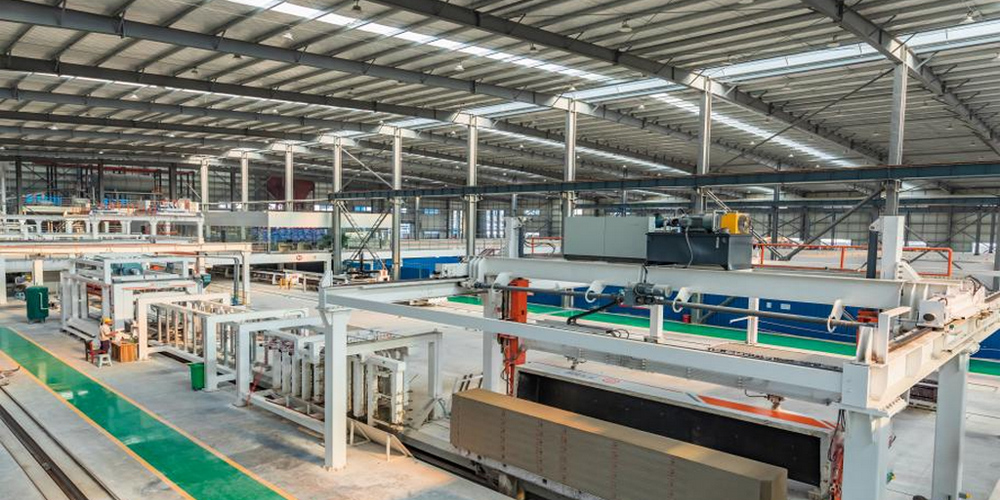
After the success of AAC, it spread across Europe, then to China, and eventually to India in the late 1900’s. Despite coming to India in the late 90’s itself, mass adoption usage of AAC blocks in India have started only in the last decade.
The key raw materials used in the manufacturing of AAC blocks and Panels are sand or Flyash, Cement, Lime Gypsum. Each material contributes to the unique properties of the product to make AAC Blocks by showing chart and steps involved in making.
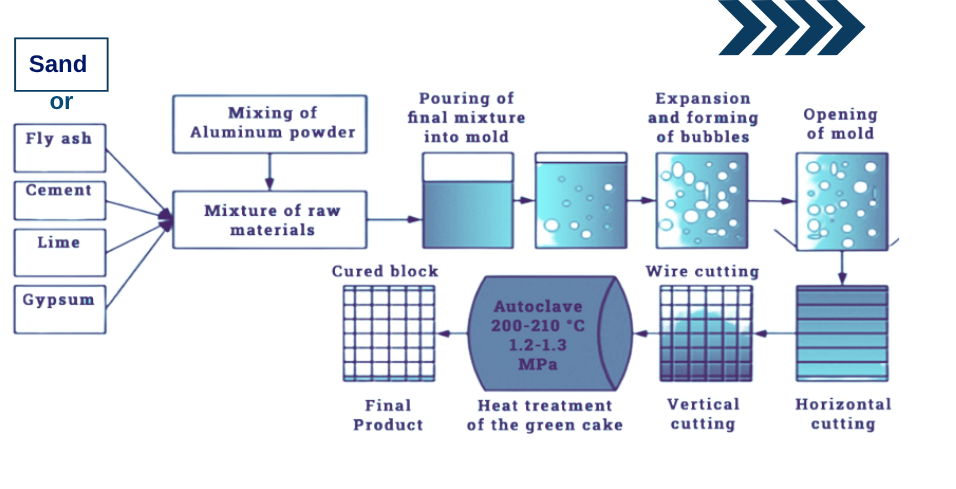
Step 1: Raw Material Preparation The raw material preparation and processing utilized in the production of Brixo AAC blocks is the first step.
They include:
- Cement: 53-grade Ordinary Portland Cement (OPC) is used to achieve the desired strength and quality.
- Fly Ash: It is a waste product of thermal power stations and forms a majority of AAC blocks.
- Lime: Lithium is powdered to facilitate breaking up into finest form to avail the chemical bonding to create block.
- Gypsum: A common building material that is employed to regulate the setting time of the mix.
After raw materials preparation, the materials are mixed proportionately in order to obtain a slurry. The ratios are usually as per strength and density to achieve. A small quantity of aluminium powder (approximately 0.08% dry weight) is added to the mixture. The addition of this introduces hydrogen gas bubbles, causing the mixture to expand and giving the lightness typical of the Brixo AAC blocks.
Step 3 – Casting, Rising, and CuringThe pre-treated slurry is subsequently cast into pre-coated molds in oil in order to prevent sticking. During placement in the molds, the aluminum reacts with the water and the calcium hydroxide to give hydrogen gas. This causes the slurry to expand and form numerous tiny bubbles of air, giving a lightweight and insulating product. The mixture is thereafter allowed to rise and pre-cure between 60 and 240 minutes depending on environmental conditions and the mix used.
Step 4 – Demoulding and CuttingAfter pre-curing, the hardened bulk or the “green cake” is sufficiently hard to be demolded. The green cake is then cut into block dimensions of the desired shape using specialized cutting tools after demolding.
Step 5: AutoclavingSteam hisses as cut blocks enter the autoclave. For 12 hours, these massive steel chambers subject the AAC to intense heat and pressure. Temperatures soar to 180°C while pressures climb between 800-1200 kPa. This high-pressure curing transforms the blocks, imparting final strength and longevity. As the process concludes, durable AAC emerges, ready for construction.
Step 6: Packaging and DeliveryPost-autoclaving, each block faces rigorous tests, meeting strict quality benchmarks. Only the best is securely packaged, safeguarding their integrity during transport. Blocks are ready to use after one day of self-curing time at atmospheric temperature.