
What are AAC blocks?
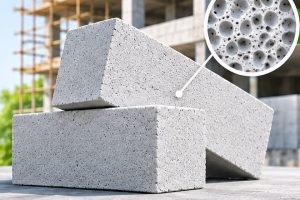
AAC stands for Autoclaved Aerated Concrete. These lightweight concrete masonry units are manufactured using a mixture of materials such as cement, lime, silica-rich material, water and a gas-forming agent.
During production, a controlled gas-forming reaction creates many small air pores throughout the material. The formed mass is then cut into blocks and cured under controlled pressure and steam in an autoclave.
The resulting cellular structure makes AAC blocks generally lighter than conventional concrete masonry units of comparable volume.
How are AAC blocks manufactured?
The manufacturing process generally follows a series of controlled stages. Exact production methods and specifications can vary between manufacturing facilities.
Raw material preparation
Suitable raw materials are selected, checked and proportioned according to the production formulation.
Mixing
The ingredients are combined with water to create a consistent slurry for the next stage.
Aeration
A gas-forming reaction creates the small pores that give AAC its characteristic cellular structure.
Pre-curing and cutting
The material gains sufficient strength before it is accurately cut into the required block sizes.
Autoclaving
The cut blocks undergo controlled steam curing under pressure in an autoclave.
Quality checks
Finished blocks are assessed against the manufacturer’s applicable quality requirements.
What are the main benefits of AAC blocks?
AAC offers a combination of material characteristics that may support construction planning and building performance. The actual outcome depends on design, installation and site conditions.
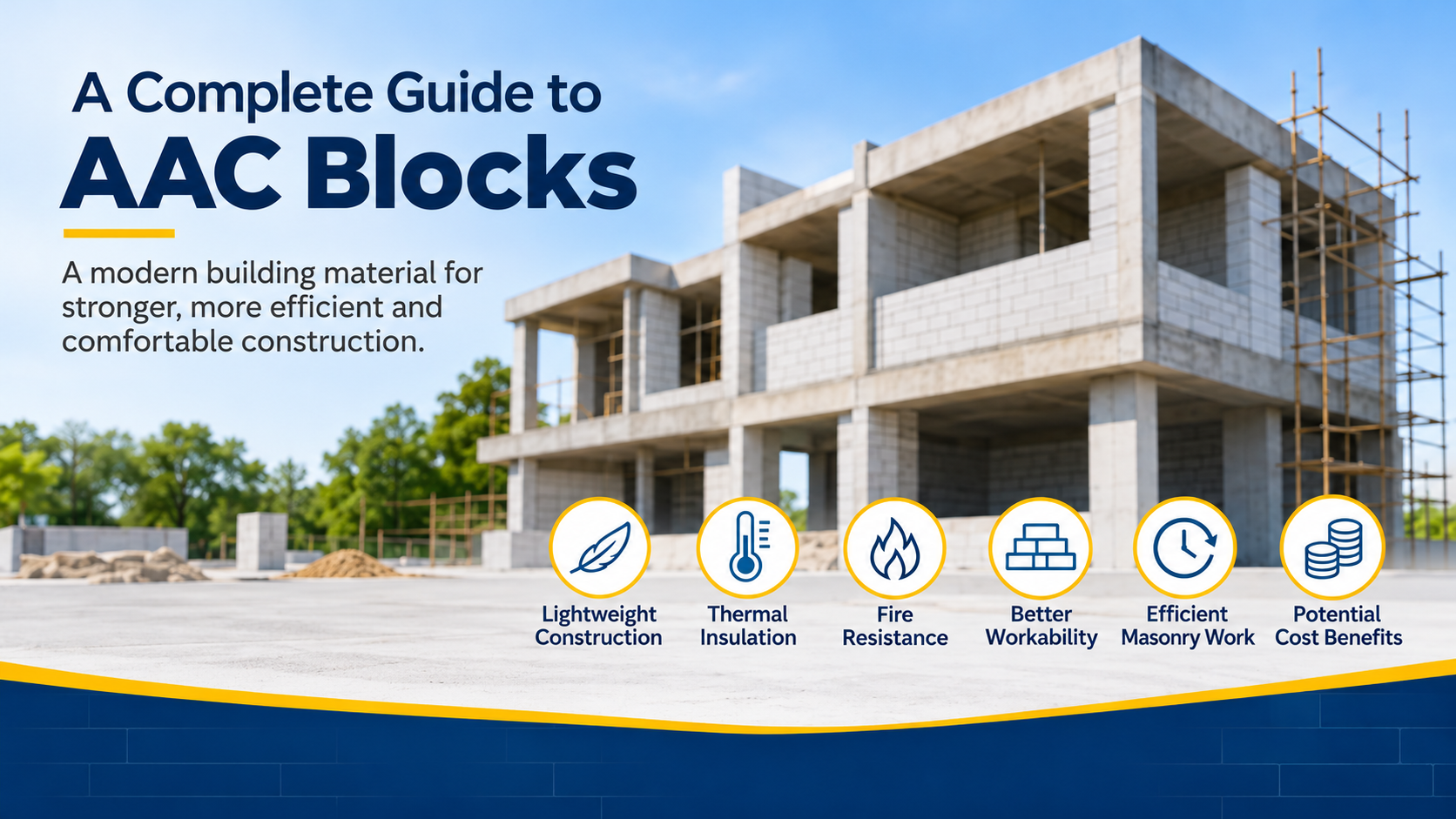
Lightweight construction
Lower density than many conventional masonry materials can help reduce the wall load, subject to structural design.
Thermal insulation
Air-filled pores help reduce heat transfer and may contribute to indoor thermal comfort and lower cooling demand.
Fire resistance
AAC is mineral-based and has fire-resistant properties. Wall performance depends on thickness and tested assembly details.
Workability
Blocks can generally be cut and shaped with suitable tools to accommodate openings and building services.
Efficient masonry work
Manageable weight and larger block dimensions can support efficient handling and laying practices.
Potential cost benefits
Evaluate total installed cost, including transport, labour, adhesive, wastage and finishing—not only purchase price.
Applications of AAC blocks
AAC blocks can be considered for a range of building applications, subject to project requirements and structural specifications.




The suitability of AAC blocks for a specific wall depends on structural requirements, applicable building codes, exposure conditions and project specifications.
AAC blocks vs. conventional bricks
AAC blocks are generally larger and lighter than traditional clay bricks. These differences can influence handling, wall installation and the overall construction process.
| Consideration | AAC blocks | Conventional clay bricks |
|---|---|---|
| Unit size | Generally larger units | Generally smaller units |
| Weight | Lower density cellular material | Typically denser material |
| Thermal behaviour | Air pores help reduce heat transfer | Depends on brick properties and wall design |
| Cutting and shaping | Can be cut with suitable tools | Usually requires appropriate masonry tools |
| Project suitability | Confirm design, specifications and installation details | Confirm design, specifications and installation details |
No single material is automatically the best choice for every project. Compare structural design, thermal requirements, local availability, labour practices and total installed cost.
How to select the right AAC blocks
Before placing an order, review the technical and practical requirements of your project with your designer, contractor or supplier.
- Required block dimensions and density
- Compressive strength and product specifications
- Dimensional accuracy and surface quality
- Compliance with relevant standards
- Transportation and delivery arrangements
- Technical guidance for installation
Request product documentation from your supplier and confirm that the selected blocks meet your project’s requirements.
Choose materials based on your project requirements.
Planning your next construction project?
Talk to BRIXO AAC Blocks about your project requirements and explore suitable AAC block options for your application.
Frequently asked questions
What does AAC stand for?
AAC stands for Autoclaved Aerated Concrete, a lightweight concrete material with a cellular structure created during manufacturing.
Why are AAC blocks lightweight?
AAC contains numerous small air pores throughout its structure. This cellular structure gives it a lower density than many conventional masonry materials.
Can AAC blocks be used in every type of building?
They can be considered for many residential, commercial and industrial applications, but suitability must be confirmed against structural design, local codes and project specifications.
What should I check before buying AAC blocks?
Review dimensions, density, compressive strength, dimensional accuracy, applicable standards, delivery arrangements and installation guidance.